
AI Is Changing Ecommerce. Most Retailers Aren't Ready.




For more than two decades, ecommerce has followed a familiar model: Consumers search for products, retailers compete for visibility, and shoppers decide what to buy.
That model isn't disappearing. But artificial intelligence is fundamentally changing how consumers discover, evaluate, and purchase products.
The biggest opportunity for retailers is more than the revenue AI-powered shopping generates today. It's preparing for a future in which AI plays an increasingly important role in determining which products consumers discover and consider.
By the time AI-powered commerce becomes a major revenue driver, the brands best positioned to compete may already have a significant head start.
From AI-Assisted Shopping to Agentic Commerce
Consider how someone might shop for a coffee maker today.
They search for "best coffee maker under $200," browse websites, compare reviews, click advertisements, and eventually make a purchase.
Now imagine that consumer asking an AI assistant:
"I want a coffee maker under $200 that makes great espresso, doesn't take up much counter space, and is easy to clean."
Instead of returning a list of links, the assistant can interpret those requirements, compare products, evaluate trade-offs, and recommend options that fit.
This is AI-assisted commerce, where artificial intelligence helps consumers research, discover, and evaluate products while the shopper remains in control of the purchase.
Agentic commerce takes that evolution further. AI systems can perform increasingly complex shopping tasks on a consumer's behalf, potentially including selected products, managing purchases, and completing transactions within authorized limits.
These experiences exist on a spectrum, but the distinction matters.
Retailers don't need to wait for fully autonomous shopping to become mainstream before AI transforms product discovery.
We're moving from a world where consumers primarily search for products to one where AI increasingly helps determine which products deserve consideration.
And that changes what it means for a brand to be discoverable.
Keywords Were Built for Search. AI Is Built for Understanding.
Traditional ecommerce advertising has largely focused on identifying and capturing consumer intent through search queries, supported by increasingly sophisticated audience intelligence and predictive optimization.
AI-assisted shopping introduces a different layer of intelligence.
Rather than relying primarily on what someone types into a search bar, AI can interpret broader historical preferences, constraints, and contextual signals.
A consumer isn't necessarily searching for "wireless headphones." They might be looking for headphones that are comfortable during long flights, work with their specific iPhone, block engine noise of specific types, and cost less than $250.
To make a useful recommendation, AI needs to understand compatibility, battery life, comfort, noise cancellation, pricing, availability, and other relevant product attributes.
This creates a new competitive challenge.
A product might perform exceptionally well in traditional search advertising yet struggle to compete in AI-assisted discovery because its information (or feed information) is incomplete, inconsistent, or difficult to interpret.
Google is already responding to this shift. In January 2026, the company announced new Merchant Center attributes designed to support conversational commerce, expanding the information retailers can provide beyond traditional product keywords.
The next competitive advantage won't come from simply bidding on what consumers type. It will also come from helping AI understand why a product is the right answer to what consumers need.
The Biggest Mistake Retailers Can Make Is Waiting
Every emerging advertising channel faces the same challenge: Brands want proof of performance before committing resources.
They want conversions, return on ad spend, and evidence that a new opportunity can compete with established channels.
That discipline is important. But judging AI-powered commerce exclusively by immediate revenue misses the bigger picture. As consumers continue to research products on AI platforms, there is more to this opportunity than sales generated by ads—there is a proven lift in visibility (and thus sales) attributed to the improvement in the organic index of proiducts.
For example, one of our clients, AFA Stores, saw a 112% increase in orders attributed to direct traffic from ChatGPT after starting to advertise on ChatGPT Ads. While advertising in ChatGPT remains separate from ChatGPT’s answers and ads are clearly labeled, this increase in direct ChatGPT orders shows a clear trend in impact.
Further, the value of preparing today extends beyond current sales. It includes building the infrastructure, expertise, and institutional knowledge required to compete as consumer behavior evolves.
We've seen similar dynamics with retail media. Brands that invested early had time to improve their product content, develop measurement capabilities, and learn how to connect advertising with broader marketplace performance.
The advantage wasn't simply that they started spending earlier.
It was that they started learning earlier.
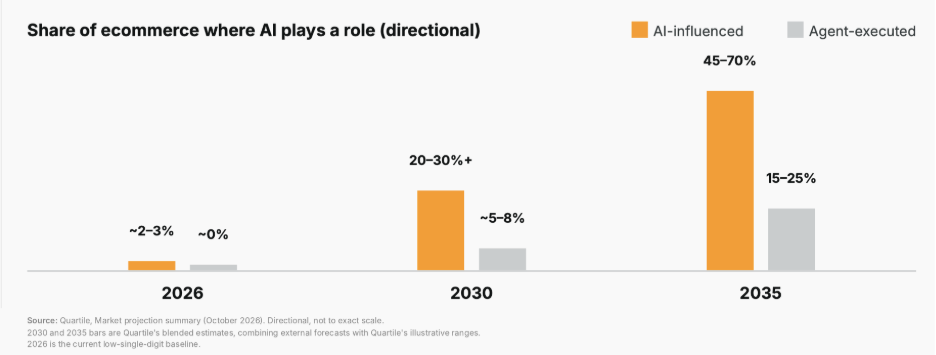
The scale of AI's future influence on ecommerce remains uncertain. Quartile's October 2026 market analysis data explored a future in which AI could influence 20% to 30% of ecommerce by 2030, with potentially greater influence in subsequent years.
Industry projections cited from Bain & Company, Gartner, eMarketer, and Flywheel Retail Insights point to significant growth in AI-influenced commerce by 2030, although estimates vary depending on how AI's role in the purchasing journey is defined.
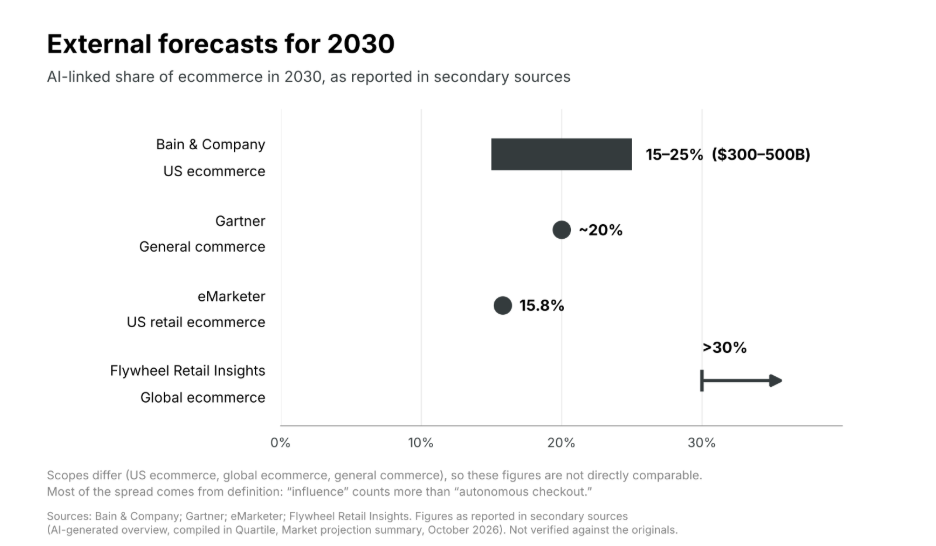
These are illustrative scenarios, not guaranteed forecasts. But retailers don't need a precise prediction to recognize the strategic implications.
AI is becoming another layer between consumers and the products they purchase.
And retailers that wait for AI-powered shopping to become a mature, high-volume sales channel may find themselves trying to solve fundamental readiness problems while competitors are already optimizing.
The cost of waiting isn't just missed revenue. It's missed learning.
Five Priorities Retailers Should Address Now
Preparing for AI-powered commerce doesn't mean abandoning the strategies that drive revenue today. It means strengthening those strategies for a changing purchase journey.
1. Make product information AI-ready. Move beyond keyword optimization. Ensure product descriptions, specifications, attributes, and differentiators clearly communicate what products do, who they're for, and which needs they address.
2. Modernize product feeds. Treat feeds as critical commerce infrastructure. Prioritize accurate pricing, real-time availability, complete attributes, consistent identifiers, and reliable updates across platforms.
3. Prepare websites for AI-driven discovery. Strengthen structured data, product architecture, and technical accessibility. Monitor emerging commerce integrations and standards that help AI systems access and interpret product information.
4. Start experimenting with AI-powered advertising and discovery. Learn how consumers describe their needs, how products are evaluated, and where information gaps create friction. Recognize that paid advertising and independent AI recommendations operate differently.
5. Rethink measurement. Traditional clicks, conversions, and ROAS remain essential, but AI-assisted shopping can influence purchases across multiple touchpoints. Retailers need to understand how these interactions contribute to consideration, acquisition, and sales across the funnel, including their impact on organic sales and performance across channels.
None of these investments requires a fully mature agentic commerce ecosystem to deliver value.
Better product data, optimized feeds, and improved product indexing can increase visibility and drive organic sales today, while stronger websites and more sophisticated measurement prepare retailers for tomorrow.
The Future of Retail Media Is Bigger Than Media
The implications of AI-powered commerce extend beyond advertising teams.
Marketing cannot solve product data problems alone. Ecommerce teams need technical infrastructure. Advertising teams need accurate catalogs, reliable measurement, and a deeper understanding of consumer behavior.
The retailers that succeed will be those that connect these disciplines.
At Quartile, we see this as an extension of a transformation already underway in retail media: moving beyond isolated keywords and campaigns toward a more comprehensive understanding of consumers and their purchase journeys.
The next era of ecommerce will reward retailers that make their products easier to understand, evaluate, discover, and purchase across an expanding ecosystem of AI-powered experiences.
That’s exactly why we are a technology partner for ChatGPT Ads.
And while the technology will continue to evolve, the strategic imperative is already clear.
The winners in AI-powered commerce won't necessarily be the brands generating the most AI-driven sales today. They'll be the brands doing the work today to become the easiest to discover, understand, and buy from tomorrow.
[CTA_MODULE]