
What Is Amazon DSP — and Is It Actually Worth It for Your Brand?




You keep hearing about Amazon DSP. Maybe a vendor pitched it, maybe a competitor mentioned it, maybe you saw it referenced in a performance report. Whatever the entry point, you're here because you want a straight answer: what is Amazon DSP, and is it worth the investment?
This guide answers that directly. Amazon DSP is one of the most powerful tools in retail media advertising — and understanding how it works, what it costs, and where it fits in your strategy is how you get the most out of it.
What Is Amazon DSP?
Amazon DSP — short for Amazon Demand-Side Platform (DSP) — is a programmatic advertising platform that lets brands buy display, video, and audio ad inventory across Amazon's owned properties and third-party websites.
The key word is programmatic. That simply means the buying process is automated. Instead of negotiating placements manually, Amazon DSP uses data to identify your target audience and serve them ads — wherever they are online — in real time.
What makes Amazon DSP different from most programmatic platforms is the data behind it. It runs on Amazon's first-party shopping signals — what people search for, browse, buy, and nearly buy. That behavioral data powers DSP targeting, and it isn't available anywhere else at the same scale or depth.
Amazon highlights four core advantages of its DSP: premium supply across owned and third-party inventory, unique audience signals built from real shopping behavior, AI-powered optimization, and interoperable technology that connects campaign data across environments.
Amazon DSP ads appear across a wide range of placements:
- Amazon.com and the Amazon app
- Amazon-owned properties like IMDb and Twitch
- Third-party websites and apps within Amazon's publisher network
- Connected TV and streaming environments
That reach extends well beyond Amazon's marketplace — which is the point. DSP finds your audience wherever they are, not just when they're actively shopping.
Amazon DSP vs. Sponsored Ads: What's the Difference?
This is the most important distinction to understand before adding Amazon DSP to your strategy.
Sponsored Ads — Sponsored Products, Sponsored Brands, Sponsored Display — are keyword-triggered. A shopper searches for something, your ad appears, they click, you pay. The model is built around active search intent. If someone is not searching, you are not reaching them.
Amazon DSP is audience-based. You're not waiting for someone to search. You're targeting people based on their behavior: what they've viewed, what they've purchased, what category they shop in. And you're reaching them across the web, not just on Amazon.
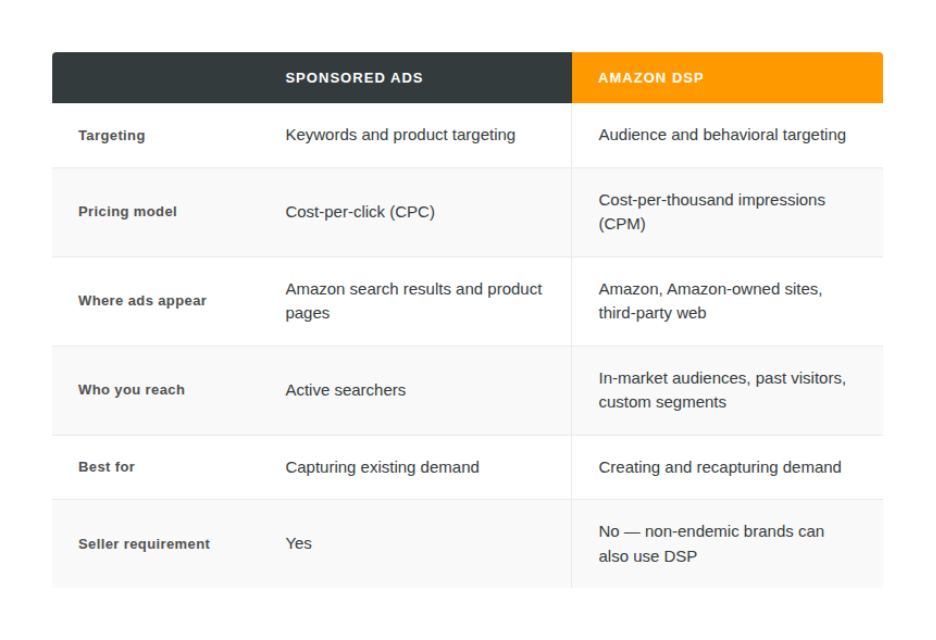
That last row matters: unlike Sponsored Ads, Amazon DSP is available to brands that don't sell on Amazon at all. Any advertiser who wants to reach Amazon's audiences — on or off Amazon — can use it.
The stronger insight is that these are not competing strategies. Sponsored Ads capture demand that already exists. Amazon DSP creates demand and recaptures the demand that didn't convert. Together, they cover the full customer journey in ways neither channel can manage alone.
[CTA_MODULE]
What Can You Actually Do With Amazon DSP?
Once you understand the targeting model, the use cases become concrete.
Retarget shoppers who viewed your product but didn't buy. Someone browsed your listing, spent time on the page, and left. Amazon DSP lets you follow up with a display or video ad — on Amazon, on IMDb, on a third-party site — and bring them back. This is the most immediate and measurable DSP use case for most brands.
Reach shoppers viewing competitor products. Amazon's data lets you target audiences who have recently viewed products in your category — including your competitors' listings. That reach isn't something Sponsored Ads can replicate.
Target by lifestyle, life stage, and purchase behavior. Amazon builds audience segments based on shopping behavior over time: pet owners, fitness enthusiasts, new parents, frequent grocery buyers. Amazon DSP lets you reach these audiences with ads that speak to their context, not just a keyword.
Suppress existing customers from acquisition campaigns. If someone already buys your product regularly, showing them a new-customer acquisition ad wastes spend. Amazon DSP lets you exclude them, tightening targeting and improving efficiency across the board.
Run video ads across Amazon-owned environments. From product detail pages to streaming content on Twitch and connected TV, video placements through Amazon DSP put your brand in front of audiences in high-attention environments — often before they're in active purchase mode.
Extend reach beyond Amazon. Because Amazon DSP connects to third-party publisher networks, brands can use Amazon's audience intelligence to reach shoppers across the broader web — applying Amazon's first-party signals to off-platform media buying.
The Types of Amazon DSP Ads
Display Ads
Static or dynamic image-based ads that appear across Amazon and third-party sites. These are the workhorses of DSP retargeting — straightforward to produce and effective for recapturing high-intent shoppers who engaged with your product but didn't convert.
Video Ads
Short-form video placements that run on Amazon-owned properties, third-party apps, and connected TV environments. Video works especially well for brand awareness and higher-consideration products where shoppers benefit from seeing the product in use before they buy.
Audio Ads
Non-visual ads that run on Amazon Music's ad-supported tier. Useful for reaching audiences during moments when screens aren't in play — increasingly relevant as streaming audio consumption continues to grow.
Dynamic Ecommerce Ads
These ads automatically pull in product information — image, price, reviews, Prime badge — and update dynamically. They reduce creative production lift and are particularly effective for retargeting because they show a shopper the exact product they previously viewed.
How Much Does Amazon DSP Cost?
DSP costs are one of the most searched questions on this topic, so it's worth addressing directly — even if the honest answer involves some nuance.
The pricing model is CPM-based, not CPC. With Sponsored Ads, you pay when someone clicks. With Amazon DSP, you pay per thousand impressions — meaning you're buying reach and audience exposure, not just clicks. This is a fundamentally different way of buying media, and it requires a different framework for measuring return.
Cost-per-thousand impressions (CPM) rates vary depending on audience segment, ad format, and placement type. Standard display inventory generally carries lower CPMs; premium video, connected TV, and high-value audience segments carry higher rates. What you pay is shaped by what you're trying to achieve and which audiences you're targeting.
There are two ways to access Amazon DSP. Amazon offers a managed service option run by its own team, which has historically required a meaningful minimum spend commitment. Self-serve access is available through qualified partners and agencies — including platforms like Quartile — which provides more flexibility on entry point while still giving brands access to expert management and optimization.
[CTA_MODULE]
The right budget depends on your goals. Unlike Sponsored Ads where spend scales predictably with clicks and conversions, Amazon DSP investment builds audience reach over time. Some return is immediate — retargeting shoppers who already engaged with your product. Some is longer-dated — upper-funnel awareness influencing future purchase behavior. How you size your Amazon DSP investment should reflect what you're trying to accomplish and how you plan to measure it.
That measurement piece is where Amazon Marketing Cloud (AMC) becomes essential. AMC provides the analytics layer that connects Amazon DSP and Sponsored Ads performance at the audience level — giving you a full view of how impressions, clicks, and conversions interact across the funnel, rather than measuring each channel in isolation.
Where Does Amazon DSP Fit in Your Strategy?
Understanding where Amazon DSP adds the most value starts with understanding your current advertising picture.
Brands running strong Sponsored Ads programs with solid Return on Ad Spend (ROAS) and meaningful product page traffic are well-positioned to add Amazon DSP. The retargeting use case alone — re-engaging shoppers who viewed a listing but didn't convert — has a clear, measurable job to do, and Sponsored Ads data helps define exactly which audiences are worth retargeting.
Brands with higher-consideration products, longer purchase cycles, or a need to build awareness in new audiences benefit from Amazon DSP's full-funnel reach. For these brands, DSP isn't just a retargeting channel — it's how they move shoppers from discovery to purchase across multiple touchpoints.
Brands earlier in their Amazon advertising journey often find the most traction by strengthening their Sponsored Ads foundation first, then layering Amazon DSP on top as traffic volume and conversion data grow. This isn't a limitation — it's sequencing. The two channels inform each other, and the combination performs better than either in isolation.
The question worth asking yourself: are shoppers reaching your product pages and leaving without buying? If yes, Amazon DSP retargeting has direct, measurable work to do right now.
Amazon DSP and Sponsored Ads: Better Together
The most effective retail media advertising strategies don't treat Amazon DSP and Sponsored Ads as separate programs. They treat them as two parts of a single system.
Sponsored Ads work at the bottom of the funnel — capturing shoppers who are actively searching and ready to buy. Amazon DSP works across the full funnel — building awareness with audiences who aren't yet searching, retargeting those who considered but didn't convert, and suppressing audiences who already purchased from new-customer acquisition campaigns.
The data flows in both directions. Sponsored Ads reveal which products convert, which audiences respond, and which search terms drive purchase intent. That information informs smarter Amazon DSP targeting. DSP reach, in turn, primes audiences who later show up in Sponsored Ads searches — arriving with more brand familiarity and higher purchase intent than cold traffic.
AMC ties both together at the attribution level. Rather than measuring each channel against its own metrics, AMC lets you analyze how touchpoints across the funnel — Sponsored Ads impressions, Amazon DSP display views, clicks, and purchases — interact and contribute to conversion. That cross-channel view is what makes the combined strategy perform better than the sum of its parts.
Quartile manages Sponsored Ads and Amazon DSP as part of a unified cross-channel strategy. Data flows across both channels, informing optimization decisions at every level — from SKU-level bid management in Sponsored Ads to audience targeting and full-funnel attribution through AMC. The result is a connected system rather than two programs running in parallel.
How to Get Started With Amazon DSP
Choose the right access model. Most brands access Amazon DSP through a managed service partner who holds DSP access and the expertise to run campaigns effectively. This matters because Amazon DSP requires ongoing audience management, creative optimization, and attribution analysis that goes well beyond setting up a campaign and reviewing results once a month. Amazon also offers self-serve access for advertisers with the in-house capability to manage it directly.
Have the right foundation in place. Before investing in Amazon DSP, you'll want:
- Clear campaign goals — retargeting, awareness, new audience acquisition, or a combination
- Product detail pages that are retail-ready: strong images, accurate titles, competitive pricing, and sufficient review volume to support conversion
- A read on your current traffic and conversion data, so you know which audiences and products are worth prioritizing
- A measurement plan — specifically, an understanding of how you'll use AMC to connect Amazon DSP performance to broader campaign attribution
What the first 60 to 90 days typically look like. Most Amazon DSP programs start with retargeting — the clearest, most measurable use case. Audiences are built from product viewers and category browsers, baseline data is established, and optimization follows from there. Awareness and upper-funnel campaigns typically layer in later, once the retargeting foundation is performing and there's a clearer picture of audience behavior across the funnel.
Working with a partner who manages both Sponsored Ads and Amazon DSP gives you the clearest view of how everything performs together — and ensures optimization decisions in one channel account for what's happening in the other.
[CTA_MODULE]
Frequently Asked Questions
What is Amazon DSP? Amazon DSP is a Demand-Side Platform that lets brands buy programmatic display, video, and audio advertising across Amazon-owned properties and third-party websites. It uses Amazon's first-party shopping data to target audiences based on real purchase behavior — reaching shoppers on and off Amazon.
How much does Amazon DSP cost? Amazon DSP uses a CPM pricing model — you pay per thousand impressions rather than per click. Rates vary by audience segment, ad format, and placement type. Amazon's own managed service has historically required a meaningful minimum spend commitment; self-serve access through a qualified partner offers more flexibility. The right investment level depends on your campaign goals and the audiences you're activating.
Can brands that don't sell on Amazon use Amazon DSP? Yes. Amazon DSP is available to both Amazon sellers and non-endemic brands — companies that don't sell on Amazon but want to reach Amazon's audiences across the web. Any advertiser looking to use Amazon's first-party audience data for programmatic advertising can access DSP through Amazon or a qualified partner.
What's the difference between Amazon DSP and Sponsored Display? Sponsored Display is a self-serve ad type within the standard Amazon Ads console. It offers retargeting and some audience targeting, but within a more limited scope. Amazon DSP provides more sophisticated audience segments, broader off-Amazon reach across third-party publisher inventory, more detailed inventory controls, and access to video and connected TV placements. Amazon DSP is more powerful and requires more active management to run effectively.
What's the difference between Amazon DSP and other demand-side platforms? The primary differentiator is Amazon's first-party data. While other DSPs rely on third-party cookies or modeled audiences, Amazon DSP is built on actual purchase and browsing behavior from one of the world's largest shopping platforms. That signal quality — and the ability to target audiences based on what they actually buy, not just what they browse — is what sets Amazon DSP apart.
Do I need a managed service partner for Amazon DSP? Self-serve access is available for advertisers with the in-house expertise to manage campaigns directly. For most brands, working with a managed service partner provides access to more sophisticated audience management, creative optimization, and cross-channel attribution — particularly when Amazon DSP is running alongside an active Sponsored Ads program. The more channels you're running together, the more a unified management approach delivers.
The Bottom Line
Amazon DSP extends your retail media advertising beyond search — reaching the right audiences before they're searching, recapturing high-intent shoppers who didn't convert, and connecting your full-funnel strategy in ways Sponsored Ads alone can't achieve.
The brands that get the most out of it treat Amazon DSP as part of a connected system: Sponsored Ads capturing active demand, Amazon DSP creating and recapturing demand, and AMC tying both together for attribution that reflects the full customer journey — not just the last click.
When you're ready to explore how Amazon DSP fits into a full retail media strategy, Quartile manages DSP alongside Sponsored Ads and cross-channel advertising as part of a unified approach — connecting data across channels to optimize toward full-funnel performance.