
What is TACoS in Amazon Advertising? TACoS vs ACoS Explained

.jpg)


If you’re running Amazon ads, you already track ACoS.
You optimize toward it. You report on it. You use it to judge performance.
But ACoS only tells you how efficient your ads are — not whether they’re actually growing your business.
That’s where TACoS comes in.
TACoS (Total Advertising Cost of Sale) is the metric that connects your ad spend to total revenue. It shows whether your advertising is driving real growth — or just shifting where sales are attributed.
What is TACoS in Amazon Advertising?
TACoS (Total Advertising Cost of Sale) measures your total ad spend as a percentage of your total Amazon revenue, including both ad-driven and organic sales.
TACoS Formula
TACoS = Total Ad Spend ÷ Total Revenue
This includes:
- Sponsored ads revenue
- Organic sales
- Repeat purchases
Why TACoS Matters
Amazon ads influence far more than attributed sales. They impact:
- Organic ranking
- Product visibility
- Click-through rate
- Conversion rate
ACoS ignores these effects. TACoS captures them.
That’s why TACoS is a more complete measure of performance.
[CTA_MODULE]
Amazon TACoS vs ACoS: What’s the Difference?
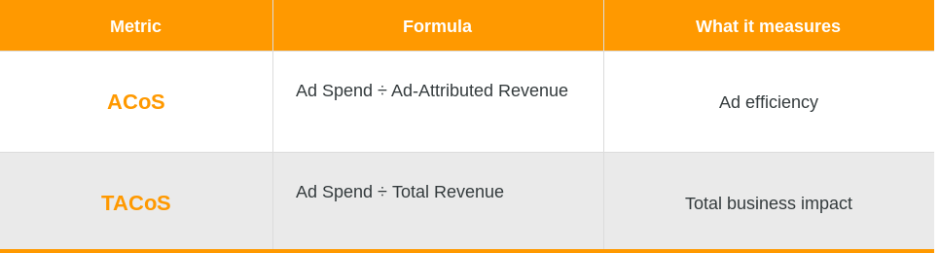
The difference between Amazon TACoS vs ACoS is simple — but critical.
The Key Insight
- ACoS = How efficient your ads are
- TACoS = How your ads affect your entire business
If you only track ACoS, you’re optimizing campaigns.
If you track TACoS, you’re optimizing growth.
Example: Why TACoS Tells a Different Story
Month 1:
- Ad Spend: $20,000
- Ad Revenue: $80,000
- Total Revenue: $200,000
- ACoS = 25%
- TACoS = 10%
Month 2 (after cutting spend):
- Ad Spend: $15,000
- Ad Revenue: $60,000
- Total Revenue: $150,000
- ACoS = 25%
- TACoS = 10%
At first glance, nothing changed.
But total revenue dropped by $50,000.
That’s the limitation of ACoS — it doesn’t show what happens to your business when you change spend.
When ACoS Looks Good but TACoS Signals a Problem
This is a common mistake:
You:
- Lower bids
- Cut keywords
- Improve ACoS
But:
- Traffic drops
- Organic rank declines
- Total revenue falls
ACoS improves because you’re spending less.
TACoS reveals that your business is no longer growing.
Why TACoS is an Important Amazon Advertising Metric
1. TACoS Reflects Total Revenue — Not Just Attributed Sales
ACoS isolates ad performance.
TACoS connects advertising to total revenue, which is how your business actually operates.
2. TACoS Captures the Organic Halo Effect
Advertising drives more than direct conversions.
It improves:
- Organic ranking
- Product visibility
- Conversion rates
As organic sales grow, TACoS decreases — even if ad spend stays constant.
That’s a sign your strategy is working.
3. TACoS Prevents Short-Term Optimization Mistakes
ACoS encourages:
- Cutting spend
- Focusing on branded terms
- Avoiding upper-funnel campaigns
These tactics improve efficiency — but often limit growth.
TACoS forces a better question:
Is this spend increasing total revenue?
4. TACoS Aligns With How Advanced Teams Operate
High-performing ecommerce teams don’t evaluate ads in isolation.
They connect:
- Demand generation
- Marketplace conversion
- Organic performance
This requires a full-funnel, data-driven approach — not just campaign-level optimization.
How to Evaluate TACoS for Your Business
There is no universal “good” TACoS.
Your ideal TACoS depends on your strategy.
[CTA_MODULE]
1. Growth vs Profitability
- Growth-focused brands
- Higher TACoS
- Focus on visibility and market share
- Profit-focused brands
- Lower TACoS
- Focus on efficiency and margins
2. Brand Maturity
- New brands → higher TACoS (reliance on ads)
- Established brands → lower TACoS (strong organic demand)
A declining TACoS over time usually indicates improving brand health.
3. Conversion and Retail Readiness
If your listings are weak, TACoS increases.
Improving:
- Product pages
- Reviews
- Pricing
Leads to better conversion and lower TACoS.
4. Strategy Alignment
Leading brands evaluate TACoS alongside:
- SKU-level performance
- Customer acquisition
- Cross-channel demand
This requires connecting data across systems — not just reading Amazon reports.
How to Reduce TACoS Over Time
Reducing TACoS is about growing revenue faster than spend — not cutting spend.
1. Improve Organic Rank
Focus on:
- Conversion rate
- Reviews
- Sales velocity
Stronger organic performance lowers reliance on ads.
2. Invest in Incremental Growth
Prioritize:
- Non-branded keywords
- New customer acquisition
- Product discovery
This increases total revenue — not just attributed sales.
3. Optimize Budget at the SKU Level
Not all products perform equally.
High-performing strategies:
- Scale top SKUs
- Reduce waste on low performers
- Align spend with margin
4. Connect Demand and Conversion
Demand doesn’t start on Amazon.
Channels like:
- Meta
- DSP
Drive traffic that converts on marketplaces.
Quartile’s approach reflects this reality. By combining cross-channel demand generation with marketplace execution, it aligns ad spend with total revenue impact — not just attributed performance.
How to Track TACoS in Amazon Advertising
What You Need
- Total ad spend
- Total Amazon revenue
Same timeframe. Consistent tracking.
Why Most Brands Don’t Track TACoS
Because data is fragmented:
- Ads live in Amazon Ads
- Revenue lives in Seller/Vendor Central
- No unified view
This leads to decisions based on incomplete data.
The Better Approach
Advanced teams connect:
- Campaign data
- SKU performance
- Cross-channel signals
Quartile does this by combining AI-driven optimization with expert-led strategy, giving brands a clear view of how advertising impacts total business performance — not just ad metrics.
[CTA_MODULE]
FAQ: TACoS Amazon Advertising
What is TACoS in Amazon?
TACoS (Total Advertising Cost of Sale) measures ad spend as a percentage of total revenue, including both paid and organic sales.
Is a lower TACoS always better?
Not always. A lower TACoS can indicate efficiency, but it may also mean underinvestment in growth. The right TACoS depends on your strategy.
What is the difference between TACoS and ACoS?
ACoS measures ad efficiency based on attributed sales. TACoS measures total business impact by including all revenue.
How do you lower TACoS on Amazon?
You lower TACoS by increasing total revenue — through better conversion, stronger organic ranking, and smarter budget allocation.
Why is TACoS important?
TACoS shows whether your advertising is driving real growth, not just attributed sales. It connects ad performance to total business outcomes.
Conclusion: TACoS is the Metric That Shows Real Growth
ACoS measures efficiency.
TACoS measures impact.
If you want to understand whether your Amazon advertising is actually growing your business, TACoS is the metric that matters.